

UN-Energy Reports
[one_sixth] [/one_sixth]Activities of Member Organizations and Partners of UN-Energy in support of “2014-2024 United Nations Decade of Sustainable Energy for All” (2016)
This report summarizes the major ongoing and future activities by UN Energy member organizations in support of “2014-2024 United Nations Decade of Sustainable Energy for All”.
[one_sixth] [/one_sixth]Activities of Member Organizations and Partners of UN-Energy in support of “2014-2024 United Nations Decade of Sustainable Energy for All” (2014)
This report summarizes the major ongoing and future activities by UN Energy member organizations in support of the Decade.
Recent Members Publications
FAO
[one_sixth] [/one_sixth]Safe Access to Fuel and Energy (SAFE) Toolbox: Woodfuel Assessment in Displacement Settings (2016)
This user guide describes how to use the Safe Access to Fuel and Energy (SAFE) Toolbox: Woodfuel Assessment in Displacement Settings for supporting field-based actors who are directly involved in the management of natural resources and protection of crisis-affected populations.
IAEA
[one_sixth] [/one_sixth]“Nuclear Power and Sustainable Development” (2016)
Transforming the energy system is at the core of the dedicated sustainable development goal on energy within the new United Nations development agenda. This publication explores the possible contribution of nuclear energy to addressing the issues of sustainable development through a large selection of indicators. It reviews the characteristics of nuclear power in comparison with alternative sources of electricity supply, according to economic, social and environmental pillars of sustainability. The findings summarized in this publication will help the reader to consider, or reconsider, the contribution that can be made by the development and operation of nuclear power plants in contributing to more sustainable energy systems.
[one_sixth] [/one_sixth]Climate Change and Nuclear Power 2016 (2016)
This publication provides a comprehensive review of the potential role of nuclear power in mitigating global climate change and its contribution to other economic, environmental and social sustainability challenges. The report also examines broader issues relevant to the climate change–nuclear energy nexus, such as costs, financing, safety, waste management and non-proliferation. Recent and future trends in the increasing share of renewables in overall electricity generation and its effect on nuclear power are also presented.
[one_sixth] [/one_sixth]Energy, Electricity and Nuclear Power Estimates for the Period up to 2050 - RDS-1/36 (2016)
Each year in Energy, Electricity and Nuclear Power Estimates for the Period up to 2050, the IAEA presents its projections of the world’s nuclear power generating capacity. The publication is now in its 36th edition.
[one_sixth] [/one_sixth]Sustainable Electricity Supply Scenarios for West Africa (2016)
The IAEA Annual Report summarizes and highlights developments over the past year in major areas of the Agency’s work. It includes a summary of major issues, activities, and achievements, and status tables and graphs related to safeguards, safety, and science and technology.
[one_sixth] [/one_sixth]IAEA Annual Report for 2015 (2016)
This publication covers topics relevant to Member States in the process of evaluation of future electricity supply options and strategies, from resource evaluation to electricity demand analysis and connections to overall social, economic and demographic developments. It is an outcome of a study carried out in West Africa, providing a coherent sub regional platform for the development of a robust policy framework for an enhanced and sustainable provision of electricity services to support socio economic growth.
IFAD
[one_sixth]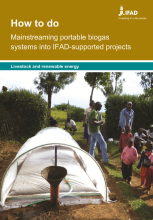 [/one_sixth]How to do: Mainstreaming portable biogas systems into IFAD-supported projects (2015)
There is a need to promote clean, modern and decentralized sources of energy as an alternative to traditional biomass fuels. This How To Do Note provides guidance for IFAD country programme managers and for policy makers and development practitioners working to achieve this goal.
UN DESA
[one_sixth] [/one_sixth]2nd Annual UN-DESA Energy Grant (2016) - Powering the Future We Want (2016)
Titled “Powering the Future We Want”, the UN-DESA Energy Grant is a capacity building initiative offers a grant in the amount of one million US dollars to fund capacity development activities in energy for sustainable development. The eight finalists of the 2016 Energy Grant Programme presented projects ranging from sustainable maritime transport, to urban electric buses with state-of-the-art technology, to compressed air mechanization for emissions-free vehicles. The finalists demonstrated through their initiatives and actions on the ground how they are contributing to the United Nations vision of sustainable energy, as embodied in the 2030 Agenda for Sustainable Development. We recognize their commitment to enhancing the role of sustainable transport in connecting people and communities to jobs, schools and health care and to the delivery of goods and services to rural and urban communities.
[one_sixth] [/one_sixth]1st Annual UN-DESA Energy Grant (2015) - Powering the Future We Want (2015)
Titled “Powering the Future We Want”, the UN-DESA Energy Grant is a capacity building initiative offers a grant in the amount of one million US dollars to fund capacity development activities in energy for sustainable development. This report highlights the mission and initiatives of the finalists of 2015.
[one_sixth] [/one_sixth]Electricity and education: The benefits, barriers, and recommendations for achieving the electrification of primary and secondary schools (2014)
This report shows that primary and secondary schools can provide students with the light, heat, comfort, and modern tools of teaching they deserve if planners, investors, and policymakers make a determined, coordinated effort at promoting electricity for education.
[one_sixth] [/one_sixth]A Survey of International Activities in Rural Energy Access and Electrification (2014)
The goal of this Survey is to highlight innovative policies that have been put into effect to stimulate electrification in rural areas of poor connection, as well as to present projects and programmes, which strive to meet this rise in energy demand and to assist communities, countries, and regions in placing themselves on a trajectory to energy sector transformation.
UNDP
[one_sixth]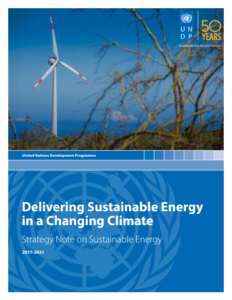 [/one_sixth]Delivering Sustainable Energy in a Changing Climate – UNDP Strategy Note on Sustainable Energy 2017-2021 (2016)
The purpose of this strategy note is to articulate – for the first time – UNDP’s role, approach and focus related to sustainable energy for the period 2017-2021. The aim is to foster internal programming coherence and clear communication to UNDP partners. This note also provides an overview of UNDP’s key partners.
ESCAP
[one_sixth] [/one_sixth]Towards A Sustainable Future - Energy Connectivity in Asia and the Pacific (2016)
This report addresses the challenges in meeting growing energy demand while ensuring that energy developments are consistent with the Sustainable Development Agenda, covering energy efficiency, renewable energy, and energy access. The report highlights opportunities and actions as well as a mechanism that can address the multiple challenges in the energy sector.
ESCWA
[one_sixth] [/one_sixth]Developing the Capacity of ESCWA Member Countries to Address the Water and Energy Nexus for Achieving Sustainable Development Goals: Regional Policy Toolkit (2016)
The water and energy nexus regional policy toolkit was prepared as part of the United Nations Development Account project on developing the capacity of ESCWA Member Countries to address the water and energy nexus for achieving Sustainable Development Goals.
UNECA
[one_sixth] [/one_sixth]Enhancing domestic private sector development in Africa: A focus on renewable energy (2016)
The present paper addresses one aspect of what some experts refer to as “modern” industrial policy in Africa by exploring how the participation of domestic private companies in renewable energy generation can be enhanced.
[one_sixth] [/one_sixth]Enhancing domestic private sector development in Africa: Construction and energy sectors (2016)
This paper explores how Governments in Africa can effectively employ interventionist industrial policies to stimulate domestic production and the growth of private entrepreneurship, especially in sectors where multinational companies currently dominate. The construction and energy sectors were chosen for this paper because they are vital for economic growth and poverty alleviation in Africa.
UNECE
[one_sixth] [/one_sixth]UNECE Renewable Energy Status Report (2015)
The UNECE and the REN21 joined forces to produce the UNECE Renewable Energy Status Report which covers 17 selected UNECE member countries located in the South East Europe, the Caucasus, the Russian Federation and Central Asia. It has been prepared in collaboration with the IEA. The report provides a comprehensive overview of the status of renewable energy and energy efficiency markets, industry, policy and regulatory frameworks, and investment activities.
[one_sixth] [/one_sixth]Analysis of National Case Studies on Policy Reforms to Promote Energy Efficiency Investments (2015)
This publication aims to identify existing barriers to energy efficiency policy implementation and to provide recommendations to the policy makers that would assist them in development and implementation of policy reforms that can support market formation and foster favourable climate for investments in energy efficiency.
[one_sixth] [/one_sixth]Best Policy Practices for Promoting Energy Efficiency (2015)
This report sets forth a suite of existing energy efficiency policies that stand out as best practices. The policies identified in this report include exemplars of best practices in energy efficiency policies from around the globe, drawn from respected and objective policy evaluations and databases.
UNECLAC
[one_sixth] [/one_sixth]Monitoring energy efficiency in Latin America (2016)
After analyzing the strengths and weaknesses of the energy efficiency programmes that the region’s countries have been implementing, the Natural Resources Unit has reached the conclusion that one of the main obstacles has been the lack of information and indicators to facilitate a quantitative, full and integrated analysis of the evolution of said policies with the objective of making policy interventions based on solid information.
UNEP
[one_sixth] [/one_sixth]Global Trends in Renewable Energy Investment 2016 (2016)
This report underlines the increasing importance of renewable energy in tackling climate change and the wider sustainable development agenda.
UNFCCC
[one_sixth] [/one_sixth]Climate Action Now - Summary for Policymakers 2015 (2015)
The Summary for Policymakers (SPM) identifies good practice policies, initiatives and actions that could be scaled up and replicated by Parties to realize significant mitigation potential in the pre-2020 period. The SPM reflects the outcomes of the associated technical expert meetings that occur under the UNFCCC. In particular, it identifies policies and initiatives in the areas of renewable energy, energy efficiency, carbon capture, use and storage, transport, non-CO2 greenhouse gases (GHGs) and land use.
UN-Habitat
[one_sixth] [/one_sixth]Sustainable Urbanization in the Paris Agreement (2016)
In this publication, UN-Habitat analyzes the Nationally Determined Contributions (NDCs) towards the Paris Agreement on Climate Change, with a special focus on the urban context, in order to understand better the roles of member states in urban climate action.
UNICEF
[one_sixth] [/one_sixth]UNICEF Annual Report 2015 (Not very much energy-related) (2016)
UNICEF Annual Report 2015 highlights results achieved for and with children and young people across the full continuum of humanitarian action and development work.
UNIDO
[one_sixth] [/one_sixth]UNIDO Energy Programme: Sustainable Energy for Inclusive Development and Climate Action (2015)
This brochure introduces the multi-faceted Energy Programme of UNIDO. By presenting its core fields of activities, new thematic areas and partnership programmes in the context of the ISID goals, it will help readers to explore further ways of addressing the global ‘energy and environment’ concerns in the Post-2015 Development Agenda.
[one_sixth]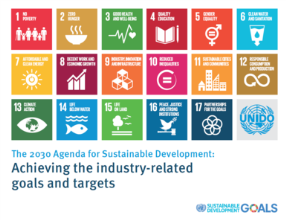 [/one_sixth]The 2030 Agenda for Sustainable Development: Achieving the industry-related goals and targets (2015)
This document summarizes the contribution of UNIDO’s mandate as well as current and planned future activities vis-à-vis the SDGs, with a special focus on SDG-9, which highlights and affirms the critical importance of ISID and its contribution to all 17 goals.
UN Women
[one_sixth] [/one_sixth]Annual Report 2015–2016 (2016)
The Annual Report documents UN Women’s work to foster women’s empowerment and gender equality around the world. It highlights some of the organization’s initiatives during the year and provides summary financial statements, a list of new programmes and projects, and contact information.
[one_sixth] [/one_sixth]Sustainable Energy for All: The gender dimensions (2013)
This guidance note provides an overview of issues related to gender equality, women’s empowerment and sustainable energy and provides guidance for UN programming and work with policy makers around sustainable energy that integrates the gender dimensions.
World Bank
[one_sixth] [/one_sixth]Sustainable Energy for All 2015 : Progress Toward Sustainable Energy (2015)
This second edition of the SE4ALL Global Tracking Framework provides an update of how the world has been moving towards the three objectives over the period 2010-2012.
WHO
[one_sixth] [/one_sixth]Health as the Pulse of the New Urban Agenda (2016)
This report considers how to integrate health into urban planning, investments, and policy decisions, so as to support the implementation and achievement of the goals and objectives of the New Urban Agenda.
Recent Partners Publications
IRENA
[one_sixth] [/one_sixth] Renewable Energy and Jobs – Annual Review (2017)
Renewable Energy and Jobs – Annual Review 2017, provides the latest employment figures of the renewable energy sector and insight into the factors affecting the renewable labour market.
[one_sixth] [/one_sixth]REthinking Energy 2017: Accelerating the global energy transformation (2017)
REthinking Energy, the flagship report from the International Renewable Energy Agency (IRENA), examines trends and developments in the global quest for a sustainable energy future. As this third edition emphasises, accelerated deployment will fuel economic growth, create new employment opportunities, enhance human welfare and contribute to a climate-safe future.
REN 21
[one_sixth] [/one_sixth]REN21 Annual Report 2016 (2017)
The report summarises REN21’s activities throughout 2016, including the latest publications, activities, and 2015 accounts. The report also outlines what REN21 will do in 2017, including the co-hosting of MEXIREC in Mexico City, 11-13 September, 2017.
[one_sixth] [/one_sixth]Renewables Global Status Report 2016 (2016)
The REN21 Renewables Global Status Report (GSR) provides an annual look at the tremendous advances in renewable energy markets, policy frameworks and industries globally.