

 |
|
Author: Alexander Müller
Publication Date: July 25, 2012
The rapid development of bioenergy, and in particular liquid biofuels, has generated considerable debate regarding their sustainability, and in particular the so-called "food versus fuel" competition. The links between bioenergy and food security are complex and multi-faceted. Making bioenergy development sustainable becomes even more challenging when one tries to capture its potential rural development, climate and energy security benefits. A sound and integrated approach is required in order to address these links and promote both "food and fuel", and ensure that bioenergy contributes to sustainable development. This approach requires:
- An in-depth understanding of the situation and of the related opportunities and risks, as well as synergies and trade-offs;
- An enabling policy and institutional environment, with sound and flexible policies and effective means to implement these;
- Implementation of good practices by investors and producers in order to reduce risks and increase opportunities; and appropriate policy instruments to promote these good practices; and
- Proper impact monitoring and evaluation and policy response mechanisms.
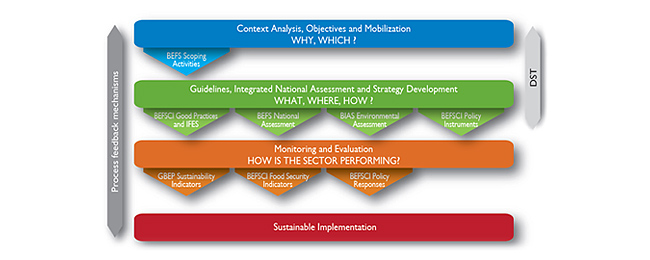
In order to promote this sound and integrated approach, over recent years FAO, partly in collaboration with partners, has developed the FAO Support Package for Decision-Making for Sustainable Bioenergy.
The support package includes five elements, which have been developed under various FAO projects and activities. They can be used independently or together at different stages and for different purposes within the decision making and monitoring processes of bioenergy development:
- The UN-Energy Decision Support Tool for Sustainable Bioenergy (DST), prepared jointly by FAO and UNEP, proposes step-wise guidance for both strategy formulation and investment decision-making processes, and offers a repository of technical resources and links to existing tools, guidelines and information resources. The DST can be seen as providing a comprehensive framework under which the other elements of the FAO support package fit.
- The primary objective of the Bioenergy and Food Security project (BEFS) is to support countries with bioenergy policy development and implementation that would safeguard food security and align with countries' socio-economic policy objectives based on a sound information set. BEFS represents the core of FAO's support to governments that wish to undertake an analysis of sustainable bioenergy potential with a focus on food security.
- The Bioenergy and Food Security Criteria and Indicators project (BEFSCI) has developed a set of criteria, indicators, good practices and policy options on sustainable bioenergy production that foster rural development and food security. Its good practices and related policies allow for risk mitigation and opportunity promotion, while BEFSCI's indicators and policy responses can be used to monitor and respond to impacts at both national and project levels. Integrated Food Energy Systems (IFES) is one type of good practice being promoted by FAO. An overview of "Making Integrated Food Energy Systems Work for People and Climate" is available on the FAO's website.
- FAO hosts the Secretariat of the Global Bioenergy Partnership (GBEP) and has significantly contributed, to GBEP's work on the sustainability indicators agreed upon in May 2011 by 23 countries and 13 international organizations, with the involvement of a further 22 countries and 10 international organizations as observers. These indicators provide a comprehensive yet practical means of evaluating the impacts of bioenergy production and use in a country and thereby informing policy development.
- The Bioenergy Environmental Impact Assessment Framework (BIAS) was developed to give a brief overview of the main environmental issues and to examine methodological options, platforms and databases and their limitations for evaluating environmental impact of bioenergy projects and policies. Issues covered include water, soil, biodiversity, gaseous emissions, land use changes and the bridging of data and knowledge gaps.
Featured Bloggers


Latest Blog Posts


