

Signup|Login
UN-Energy
  • About
    • Overview
    • Members
    • Chair, Vice Chair & Secretary
    • UN-Energy Africa
    • Terms of Reference
    • Meetings of UN-Energy members
  • Activites
    • Overview
    • Energy Access
    • Renewable Energy
    • Energy Efficiency
    • Featured Activities
  • Resources
    • Energy Stories
    • Publications
    • News Feed
    • Newsletter
    • Events
    • Workshops
    • Tools
    • Links
  • Blog
  • Contact
Newsletter
Newsletter archive
The UN-Energy Newsletter • Issue 06 • September 2012
In this issue:
New Leadership for Sustainable Energy for All initiative
The UNEP/GEF en.lighten Toolkit
Global South-South Development Expo 2012
FS-UNEP: The Thai Energy Efficiency Revolving Fund

Sustainable Energy for All: Nigeria National Launch

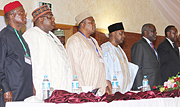
The Sustainable Energy for All initiative was inaugurated as a Nigerian national effort in Abuja on August 23rd. 2012. The Nigerian federal government is intent on achieving the goals of initiative even earlier than the 2030 mark set by the global initiative. The launch was convened by the Nigerian federal government, UNIDO, the UN Foundation and the UN Secretary-General's office. Nigeria's President Goodluck Jonathan has reiterated his country's full commitment to achieving the targets of Sustainable Energy for All by the year 2020 and encouraged UNIDO and its other development partners to continue and support the country's efforts in achieving access to sustainable energy for all in order to advance the socio-economic conditions and eradicate poverty. UNIDO's Director General and Special Representative of the Secretary-General for Sustainable Energy for All Kandeh Yumkella has said that the goal of sustainable energy for all by 2030 would not be accomplished without Nigeria, and commended the Nigerian government for their leadership role in endeavoring to expand access to energy. On the heel of the launch Nigeria has announced multiple exciting avenues in order to realize the goal. These include: an investment of 8 Billion USD on power intervention projects, an added 5000 Megawatts from 10 new plants by 2013, increasing hydropower generation, a plan to deliver uninterrupted power by the end of 2012 and increasing access to energy in Borno and Kaduna.
Sustainable Energy for All


Upcoming Events
ECOWAS High-Level Forum: Paving the Way for Sustainable Energy for All in West Africa through Renewable Energy and Energy Efficiency
Accra, Ghana
Monday, October 29, 2012
through
Thursday, November 1, 2012

GEF Council Meeting
Washington, United States of America
Monday, November 12, 2012
through
Saturday, November 17, 2012

Global South-South Development (GSSD) Expo 2012
Vienna, Austria
Monday, November 19, 2012
through
Saturday, November 24, 2012

UNFCCC COP 18
Doha, Qatar
Monday, November 26, 2012
through
Saturday, December 8, 2012

International Conference on Energy and Urban Sustainability: Transforming Municipal Solid Waste into Energy
Tehran, Iran, Islamic Republic of
Wednesday, December 12, 2012
through
Friday, December 14, 2012

New Leadership for Sustainable Energy for All initiative

UN Secretary-General Ban Ki-moon today strengthened his commitment to achieving sustainable energy for all by announcing new leadership arrangements for his Sustainable Energy for All Initiative. In an address to UN Member States and other stakeholders at a High-level Event on the margins of the UN General Assembly meeting in New York, the Secretary-General confirmed that he had asked Dr. Kandeh Yumkella, currently the Director-General of the UN Industrial Development Organization and Chair of UN-Energy, to serve as his Special Representative for Sustainable Energy for All and chief executive of the initiative. The Secretary-General also announced that he had invited the President of the World Bank, Dr. Jim Yong Kim, to serve with him as co-chair of the initiative's newly formed Advisory Board. "Providing sustainable energy for all could be the biggest opportunity of the 21st century," said the Secretary-General. "Sustainable energy is the golden thread that connects economic growth, social equity, and a climate and environment that enables the world to thrive. This initiative is bringing together governments, the private sector, and civil society in a partnership that's delivering real results."

The initiative has three objectives: to provide universal energy access; to double the rate of global energy efficiency improvement; and to double the share of renewable energy in the global energy mix. The new arrangements announced by the Secretary-General for the Sustainable Energy for All initiative include:

  • Creation of an Advisory Board, to be appointed by the Secretary-General and co-chaired by the Secretary-General and World Bank President. The Advisory Board will provide strategic guidance to the work of the initiative. Its members, which will be announced soon, will be drawn from the private sector, civil society and governments that have shown exceptional leadership;
  • Creation of an Executive Committee, to be chaired by Chad Holliday, Chairman of Bank of America. The Executive Committee will provide operational oversight for the work of the chief executive as he carries out the functions of Sustainable Energy for All;
  • Designation of Dr. Kandeh Yumkella as Special Representative of the Secretary-General for Sustainable Energy for All and chief executive of the effort. The chief executive will be fully responsible for planning and implementation of the initiative to achieve its ambitious objectives.

At the High-level Event event, significant new commitments to action in support of achieving Sustainable Energy for All were also announced. These include:

  • Inter-American Development Bank (IDB): Commitment of $5 Billion in 5 years to SE4ALL related work in the Latin American and Caribbean region.
  • Philips: Will install 100 "light centres" across rural Africa.
  • World Economic Forum Green Growth Action Alliance: Will help secure financing by facilitating the pooling of funds or renewable energy purchases.
  • Sustainable Endowments Institute Billion: Green Challenge encouraging universities and other nonprofit institutions to invest a combined total of $1 billion in self-managed revolving funds that finance energy efficiency improvements.
  • Suntech Power Holdings: Will donate up to 300 kilowatts of solar panels to the Panzi Hospital in Bukavu, Democratic Republic of Congo.

Embedded below is a short summary video of the announcment.


The UNEP/GEF en.lighten Toolkit

Electricity for lighting accounts for almost 20 percent of electricity consumption and six percent of CO2 emissions worldwide. If not addressed immediately, global energy consumption for lighting will grow by 60 percent by the year 2030 which would have dramatic consequences for climate change. The phase-out of inefficient incandescent lamps and their replacement with higher efficiency products provides one of the most straightforward and cost-effective ways to significantly reduce carbon emissions.

The en.lighten initiative has been established to accelerate the market transformation to environmentally sustainable lighting technologies worldwide by developing a coordinated global strategy and providing technical support for the phase-out of inefficient lighting. This will lead to a significant reduce of global greenhouse gas (GHG) emissions to mitigate climate change. It is a public-private partnership between the United Nations Environment Programme (UNEP) and the Global Environment Facility with support from efficient lighting leaders, OSRAM AG and Philips Lighting, and the National Lighting Test Centre (China).

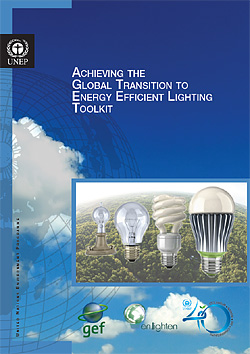
The new en.lighten Toolkit "Achieving the Transition to Energy Efficient Lighting" is an unparalleled centralized resource for providing guidance for countries to transform their markets to efficient lighting. This comprehensive tool serves to align all of the current methodologies and actions of countries around the world that are already involved in, or considering the phase-out of inefficient lighting. It highlights examples of best practice in important areas such as; policy development, regulations and standards.

The Toolkit is a practical reference manual that identifies many of the essential elements that need to be considered before and after inefficient lighting phase-out schemes have been initiated, including all of the elements of the en.lighten integrated approach. The content of the Toolkit has been presented in practical, action-oriented terms to be utilized primarily by those responsible for drafting policies – environment or energy departments or agencies – but also by public utilities, private sector and civil society organizations.

The Toolkit is backed by an international network of lighting experts who are available to assist countries through an online support centre which is in development. Additionally, webinars and training will be delivered that will specifically address the challenges and opportunities in order to ensure a successful global transition to efficient lighting. The Toolkit is currently being transformed into a navigable, searchable, downloadable online resource and translated into the official UN languages.

Download the en.lighten Toolkit
The en.lighten Newsletter


Global South-South Development Expo 2012
Energy and Climate Change:
Inclusive Partnerships for Development

Incepted in 2008 by the Special Unit for South-South Cooperation (SU-SSC), a part of the United Nations Development Programme (UNDP), the Global South-South Development (GSSD) Expo is an important mechanism to promote South-South solutions, and a major venue for interactions among like-minded partners. Together with the Global South-South Development Academy and the South-South Global Assets and Technology Exchange, the GSSD Expo is part of the United Nations' 3-in-1 multilateral support architecture dedicated to South-South Cooperation.

This year's event will be hosted by the United Nations Industrial Development Organization (UNIDO) in Vienna, Austria, and co-organized with the Special Unit for South-South Cooperation (SU-SSC). When asked to host the Expo, UNIDO immediately seized this opportunity as it positively reflects on its own commitment to South-South cooperation, for which it received the 2011 South-South Innovation Award. Furthermore, hosting the event enables the Organization to more actively foster interactions on the thematic priorities that are core to its mandate.

2012 is the International Year of Sustainable Energy for All, and developing countries also strive for inclusive partnerships for sustainable development in the field of Energy and Climate Change. Furthermore, the theme, which also pays tribute to UNIDO's strength in delivering environment and energy-related solutions, fully resonates with the main topics that were discussed throughout the year, including in Rio.

With the GSSD Expo 2012 overarching theme being "Energy and Climate Change", UNIDO and its co-organizers have taken a number of steps to reduce the ecological footprint of the event; seen together, these numerous initiatives demonstrate the United Nations' commitment to work in an environmentally-friendly manner.

The Expo will showcase successful initiatives from developing countries that address the development challenge, six major energy oriented solution forums and multiple mini forums, as well as host a general exhibition floor. By participating in the forthcoming GSSD Expo, you will therefore be able to:

  • Interact with high-level government officials and representatives from the international community as well as with the private sector, academia and the civil society
  • Showcase innovative technologies and present best practices related to Energy and Climate Change issues
  • Learn from valuable experiences in South-South Cooperation and ascertain upcoming trends and evolutions related to Energy and Climate Change in the South
  • Network with like-minded potential partners, both from the public and the private sector, towards developing mutually beneficial relationships

GSSD Expo 2012 Site


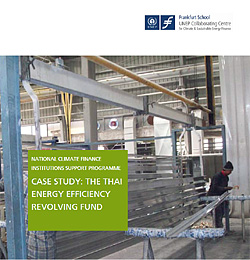
FS-UNEP: The Thai Energy Efficiency Revolving Fund

Even though most Energy Efficiency (EE) technologies are commercially competitive barriers still exist to their deployment and scale-up. To harness adequate funding to cover upfront costs and encourage private sector investment, financial commitments made by the public sector are often channeled via financial mechanisms. These mechanisms, known sometimes as "public funding mechanisms" (PFMs) or "public finance instruments" (PFIs), help to align market actors, correct market failures and reduce the perceived and actual risk of low-carbon investments. As such, financial support mechanisms can enhance national government policy actions in combating climate change.

Launched by the Government of Thailand (GoT) in 2003 as part of its Energy Conservation Programme, the Thai Energy Efficiency Revolving Fund (EERF) works to overcome barriers within the Thai financial sector to stimulate adequate financing for EE and reduce the country’s GHG emissions. Because of its success in leveraging private capital with government financing, the EERF can be considered a model financial support mechanism for jump-starting investments in EE.

The principle goal of the EERF is to stimulate the investment appetite of commercial banks in Thailand so that they will engage in financing EE projects. When considering the fund's project results, one could say that the GoT (acting through the EERF) has achieved this goal. For example, among the funds' eleven PBs are most of the large Thai commercial banks, which are increasingly investing their own capital in EE projects. In fact, the fund has been designed so that most of them no longer need to use the EERF fund facility. Another key achievement is that the government was able to jumpstart the EERF with the initial capital with almost zero risk. This was possible because the fund primarily finances tested products and the capital was sourced from petroleum import tax revenues. This form of innovative financing lightens the strain on government budgets in providing this type of upfront financing, thus making it more sustainable.

The case study offers a sufficient background to the development of the EERF and provides an overview of the macroeconomic situation and the evolution of climate change policies in Thailand. It focuses on the EERF, its funding sources, design, administration, and impacts, including project examples and energy savings.

Download the Case Study


New UN-Energy Smartphone App

UN-Energy has released a Smartphone App for the Android platform. The App provides a quick list view of the most recent content items published on the Knowledge Network. This includes: Stories, Events, Publications, Newsletters, Blogs, Workshops, Tools, News and Tweets. Each listed item is further linked to an expanded view of it on our Knowledge Network and on the web. The App's main feature is to alert the user's phone when updates are available, which it does by notifying the end-user whenever new content is published online.

The App can be installed on an Android compatible device, phone or pad and is compatible with all versions of Android since its release as a platform and up to now. The app is especially optimised for low data bandwidth and prolonged battery life. Along side this App another Android App with similar features for the Clean Energy Solutions Center is also being released.

The App can be downloaded and installed via the Google Play store linked below.

Get the UN-Energy App


HomeTerms of UsePrivacyContactRSS