

 |
|
Through its joint programmes and the variety of activities implemented by its individual members, UN-Energy has undertaken considerable efforts to enhance sustainable access to energy in support of the achievement of the Millennium Development Goals (MDGs), the Secretary General's Sustainable Energy for All (SE4All) initiative, and the new Sustainable Development Goals (SDGs) of the Post-2015 Development Agenda. SDG #7 calls to “ensure access to affordable, reliable, sustainable and modern energy for all". Target 7.1 seeks to ensure universal access to affordable, reliable and modern energy services by 2030. UN-Energy members combine valuable experience in helping governments, the private sector, local communities and other stakeholders. They support important institutional reforms to create transparent, well-governed energy markets and leverage private-sector participation. UN-Energy members’ access programmes strongly focus on expanding energy services in rural areas, urban slums and the poorest communities as a fundamental means of reducing poverty.
Capacity-building
Capacity-building and training activities constitute key ingredients of successful initiatives aimed at enhancing energy access. They foster ownership by stakeholders and increase the likelihood of sustainability after the withdrawal of external partners. Such activities further develop the local expertise required to allow for the replication and scaling up of successful initiatives. Strengthening capacity of stakeholders at all levels, from local communities to private sector as well as regional authorities and national governments, is therefore one of the core components of energy access programmes proposed by Un-energy members.
UN DESA promotes access to affordable, modern energy services, which are essential for the achievement of sustainable development and the accomplishment of the SDGs. UN DESA’s activities focus on providing the needed energy services in developing countries, particularly in rural areas, by enhancing capacitybuilding, transferring low-carbon energy technologies (such as renewable energy and energy-efficiency technologies), facilitating financing, and fostering regional and international collaboration. UN DESA has launched the Minimum-Electricity Access (Min-E Access) initiative to provide households, schools, and communities in isolated rural areas with a minimum amount of electricity through stand-alone (off-grid) renewable energy technologies such as solar PV. In order to ensure the sustainability of this public-private partnership, funds are mainly channelled to the two major modules of (1) capacity building and (2) entrepreneurship development on the local level.
Strengthening national and local capacity within governments, the private sector and civil society to foster the expansion of access to modern energy services for the poor is the key component of UNDP’s action in the energy sector. UNDP strengthens national policy frameworks for energy and catalyzes financing through market creation or transformation for sustainable energy programmes, particularly renewable energy and energy-efficiency initiatives. This includes expanding energy access service delivery at the local level, particularly for decentralized off-grid energy technologies. It also includes capacity-building to improve the operational efficiency of energy utilities to increase both their viability as modern businesses and their ability to deliver services to a wider set of customers, particularly the poor.
UN DESA’s Capacity-building for Interregional Electricity Access and Supply in Africa Project (US$ 591,000 of UNDP/GEF funds) aims at strengthening the capacity of regional economic communities and their member States to establish appropriate policy, institutional and regulatory frameworks for regional electricity grid interconnection in order to increase access to electricity and security of supply.
The GEF Strategic Programme on Energy in West Africa, (US$ 45 million of own funding and more than US$ 200 million of co-financing), coordinated by UNIDO, is one example of joint programming within UN-Energy. In a concerted effort, UNIDO, the World Bank, UNDP, UNEP, FAO, the African Development Bank and the International Fund for Agricultural Development (IFAD) aim to promote energy access in rural areas through renewable energy and energy efficiency projects in 18 countries. Capacity-building is an integral part of this programme, which builds on energy as a prerequisite for poverty reduction through income generating and productive activities and aims to show technical feasibility and economic viability of renewable energy and energy-efficiency projects in participating countries. The Strategic Programme in West Africa, Climate Change Component furthermore, focuses on knowledge management and emphasizes the exchange of lessons learned and best practices. The programme will be backed by the newly established and UNIDO-supported ECOWAS Regional Centre for Renewable Energy and Energy Efficiency (ECREEE) located in Praia, Cape Verde. ECREEE’s activities focus on, among others, capacity building for markets players and enablers, policy development and quality assurance, technology transfer, and knowledge management.
The IAEA assists its member States in strengthening the expertise required to conduct national energy assessments and design energy strategies and policies. This assistance includes the transfer of updated information and assessment tools (such as energy models) and the training of experts in the use of these tools so they can chart national energy demand and supply strategies consistent with their national development objectives. In addition, the IAEA supports national and regional energy assessments and topical 3E (energy, economy, environment) studies—for example, assessing the economic implications of energy technology choices and analyzing cost-effective energy options for mitigating climate change. The IAEA works closely with all of its member States and interacts actively with several partners, including UN DESA, IEA/OECD and the Intergovernmental Panel on Climate Change (IPCC).
The IAEA’s Programme Activities in Support of Sustainable Energy Development (annual budget of US$ 7 million) aim to enhance the capacity of member States to perform their own analyses regarding energy system development, energy investment planning and energy-environment policy formulation, and to help member States plan for the introduction of nuclear energy or to help keep the nuclear option open for those who wish to retain it.
FAO considers bioenergy development as a potential opportunity for developing countries. FAO works on the introduction of innovative rural energy access solutions into global strategies for rural development, environment protection and food security. FAO’s work on bioenergy aims to build and strengthen institutional capacity at all levels, generate information that will support decision-making for sustainable bioenergy development, enhance access to energy services through sustainable bioenergy systems, and facilitate opportunities for effective international exchange and collaboration.
Enabling environments
Establishing enabling environments at policy, regulatory and market levels is a prerequisite for the sustained development of energy access initiatives. This is reflected in the strong engagement of Un-energy members in such projects, including joint actions on supporting the design of sustainable development strategies, the formulation of subsequent energy policies and regulations, and the creation of favourable market conditions. Un-energy programmes also foster regional cooperation to assist national governments and other stakeholders in the creation of environments conducive to enhancing access to modern energy services.
UNDP works to integrate energy considerations into national development strategies, including povertyreduction strategy papers (PRSPs), climate change strategies, and various national and sectoral policies, plans, programmes and budgets. It also facilitates multisectoral and multistakeholder dialogues to support informed decision-making on national energy targets, policy and institutional options, including financial responses to energy access challenges.
The Reform Energy Planning Project at UNDP aims to ensure that institutional and organizational structures, mandates and functions are appropriate for increasing energy access. This Project has contributed to the creation of the National and Sectoral Analysis of Energy Access and Development in Kenya and the Regional Policy on Access to Energy Services for Poverty Reduction, which has been adopted by the Economic Community of West African States (ECOWAS).
Lighting Africa is a joint programme from the International Finance Corporation (IFC) and the World Bank, also involving the GEF as partner and UNDP and UNHABITAT as member organizations. Lighting Africa currently has a budget of roughly US$ 12 million provided by its variety of partners. It supports the global lighting industry in developing affordable, clean and efficient lighting and energy solutions for the millions of people in SSA currently without access to the electricity grid. Efficient lighting solutions such as the latest light-emitting diode (LED), fluorescent and solar technologies have finally made it possible to offer energy services that are clean, efficient and reliable— and at price points that are comparable to kerosene. This programme’s objective is to leverage global expenditures on fuel-based lighting to develop, accelerate and sustain the market for modern off-grid lighting alternatives that offer African consumers greater value for their money.
UNECA’s Regional Integration, Infrastructure and Trade Division helps member States formulate policies and strategies to promote good practices for the development of the African energy sectors. Areas of intervention include coordinating United Nations organizations working in Africa on energy issues (in support of the New Partnership for Africa’s Development (NEPAD) through UN-Energy Africa); improving Africa’s energy sector management through policy analysis, studies and capacity-building; fostering regional energy cooperation and integration; and developing policies for improving energy accessibility in Africa.
The strategic goal of ESCAP’s Energy Security Section is to promote inclusive and sustainable development in Asia and the Pacific. It advocates a paradigm shift in energy production and use—to improve energy access for the poor, ensure the energy security needed for rapid economic development and social advancement, and enhance environmental sustainability at national, regional and global levels.
Financing
Enhancing sustainable access to energy requires robust financing mechanisms that address the specific needs of key stakeholders. These include cross-subsidies, loans, grants or guarantees as instruments to address the energy access-related financing needs of utilities, national or local governments, NGOs, private sector companies and end-users. The expertise and services provided by all UN-Energy members contribute substantially to creating optimal financing conditions for supporting energy access in developing countries.
UN-DESA, in collaboration with the China Energy Fund Committee (CEFC), a Hong Kong based NGO in consultative status with ECOSOC, has launched the project "Powering the Future We Want - Recognizing Innovative Practices in Energy for Sustainable Development". In order to advance the implementation of sustainable development, it offers a one million US dollar grant annually to institutions and/or individuals that have demonstrated leadership and innovative practices in promoting sustainable energy and meeting the global energy challenge. The recipients of the grant are expected to apply the funds to furthering their best practices and to building capacity in developing countries.
ESCAP’s Trans-Asian Energy System project seeks to promote enhanced energy cooperation through greater coordination and integration of the Asia-Pacific regional energy system, enabling energy exchange and trade in support of sustainable development. Its goals include enhanced access to broader energy markets for exporting countries, easier access to energy supplies for countries not endowed with fossil energy resources, decreased dependency on energy supplies from outside the region, and the establishment of an intergovernmental collaborative mechanism. ESCAP closely cooperates with subregional organizations in the energy sector, including the World Bank, the Association of Southeast Asian Nations (ASEAN) and the Asian Development Bank.
The World Bank Group seeks to increase access to reliable and affordable modern energy services, particularly for the poorest, through a lending programme that includes direct investment in new energy projects and sector-specific policy advice to client countries. In its fiscal year ending on 30 June 2009, the World Bank Group committed a record US$ 8.2 billion in new energy financing, more than 40 per cent of which was for renewable energy and energy efficiency. Additionally, US$ 2.2 billion of the total US$ 8.2 billion was allocated to increase access to energy in low- and middle-income countries, a four-fold increase since UN-Energy’s inception in 2004. In the past year, to meet interim financing needs until a post-2012 mechanism for climaterelated energy investments is finalized, the World Bank Group developed the Climate Investment Funds, a US$ 6.3 billion commitment that has seen plans for investment drawn up for thirteen countries and two transformative clean energy projects approved in Turkey and Mexico.
In addition, the World Bank is home to a number of initiatives that build and share best practices in energy, provide additional climate financing for energy projects and target specific needs in the energy sector. For instance, the Energy Sector Management Assistance Programme (ESMAP) aims to increase institutional knowledge and capacity to achieve environmentally sustainable energy solutions for poverty reduction and economic growth by investing US$ 55 million between 2008 and 2013. Other important technical advisory activities by the Wold Bank include the development of guidelines for electricity systems design and construction, and procedures for calculating rural tariffs and norms.
Under ESMAP, the World Bank works in close cooperation with UNDP and bilateral donor organizations to conduct Country Power Sector Vulnerability Assessments. Considering the global financial crisis, highly volatile energy prices and climate variability, developing countries are considered to be very exposed to a highly turbulent energy environment. The Country Power Sector Vulnerability Assessments aim to determine the level of vulnerability in the power sector for each participating country. The first set of assessments was finalized in 2009 for Indonesia, the Philippines and Viet Nam. Another set of assessments is currently underway for the 2010 fiscal year. Hydroelectric resources often require joint community management, participation, leadership, teamwork and coordination. As an example, under a GEF project in Sri Lanka, mini-grid hydro installations were built, owned and operated by local communities through electricity cooperatives that were set up specifically for the purpose.
The GEF, housed at the World Bank, finances access to energy services in rural areas where expansion of the grid is neither cost-effective nor affordable. Since its inception, the GEF has helped countries deploy solar energy technologies in remote areas by funding 70 projects in 69 countries to provide access to electricity through the use of solar home systems and off-grid photovoltaic electricity. The GEF supports these projects with US$ 360 million, co-financed at a ratio of 1:7 by other donors. These projects include the installation of an estimated nominal peak power of 124 megawatts (MW). These projects led to the rapid growth of the photovoltaic (PV) industry in several countries, improving the quality of production, reducing costs and expanding the market for solar home systems and other off-grid PV applications. In addition, the GEF helps disseminate small hydro technologies by supporting 44 projects with own funding amounting US$ 170 million and US$ 1.3 billion of co-financing. Among other outcomes, these investments have led to the installation of a total capacity of 411 MW, mostly for rural and decentralized electrification purposes. UNDP has an on-going programme portfolio on energy of US$ 2.5 billion, with more than 1,500 energy projects at national, local and community levels in more than 100 developing countries. These projects expanded direct access to modern energy services to more than seven million people who had previously not been benefiting from such services. As another example of partnerships between UNEnergy agencies, the UNDP/GEF Small Grants Programme has financed the implementation of more than 1,000 energy access-related projects in more than 60 countries since 1992, helping extend access to modern energy services to more than two million people at the local level. With a suite of innovative approaches aimed at addressing climate change objectives, this programme has shown great potential as an effective tool for fostering national replication and the expansion or mainstreaming of energy access initiatives.
Further concrete examples of the scope of the financial services UN-Energy’s members provide related to energy access issues are mentioned under the description of the activities attributed to the remaining clusters of UN-Energy. This is especially true for the section presenting initiatives focusing on renewable energy, which often directly provide access to energy services as part of their activities.
Knowledge sharing
Ensuring access to relevant knowledge and expertise is key to empowering stakeholders to take informed decisions on the design and implementation of initiatives to enhance energy access, in particular in the context of rapidly evolving technologies. information dissemination and knowledge sharing are therefore important objectives among Un-energy members’ programmes for energy access, as these permit project developers and stakeholders to effectively build on existing experience, lessons learned and best practices identified, both within the United nations system and externally. Therefore, almost all the programmes implemented contain dissemination activities, some examples of which are provided below.
ClimDevAfrica is a regional initiative jointly undertaken by the African Union Commission, UNECA and the African Development Bank. It aims at enabling effective adaptation activities in climate-sensitive sectors, strengthening Africa’s climate and development institutions, filling gaps in climate information and analysis, and enhancing the use of climate information in decision-making. As part of this programme, UNECA established in 2009 the African Climate Policy Centre (ACPC), which amounts to an investment of US$ 35 million over four years. The objectives of ACPC concentrate on facilitating effective adaptation initiatives in the sectors most impacted by climate change, including energy. Climate-proofing energy production and distribution—to ensure continuity of access—is a major issue that needs to be considered carefully. This programme is mainly focused on knowledge management, analysis and options needed by decision-makers at all levels.
Encouraging knowledge sharing among member States and their institutions is a key task for the IAEA, which conducts important work on energy supply strategies. The organization recently launched a collaborative effort to analyse the interdependencies and linkages between climate, land use, energy and water (CLEW), using different models to assess the overall energy and natural resources situation of a given country with particular emphasis on avoiding conflicts in land-use and water demand for food and biofuel production.
Increasing access to modern, clean and reliable energy services, especially for the urban poor, is a priority of UN-HABITAT. Considering the large potential for income generation in municipal solid waste management, UN-HABITAT organizes information exchanges and encourages collaborative arrangements that promote intelligent waste collection and sorting combined with biogas generation, composting and waste-to-energy/ recycling partnerships with industry. In addition to providing advisory services to member States, ECLAC prepares and disseminates various sectoral studies on energy perspectives for specific countries or regions. It also organizes seminars and training courses and provides technical support to develop national capacities for energy projects. The UNCTAD Biofuels Initiative provides member countries with economic, legal and trade policy analysis, capacity-building programmes and consensus-building tools. It helps assess the potential of specific developing countries to engage in the production, use and trade of biofuels.
In many of the poorest areas of the developing world, solid fuels are typically burned in simple, unvented fires— often indoors—which lead to high levels of household air pollution. This is estimated to cause nearly two million premature deaths annually. To monitor the situation, WHO is expanding and maintaining a Household Energy Database. Already containing data from more than 500 nationally representative surveys conducted in 143 countries between 1974 and 2008, this database will be publicly available through the WHO Global Health Observatory (provisionally by mid-2010) and will be used for research on trends and socioeconomic inequalities in energy access and health impacts. In addition to information on the type of fuel used in rural and urban areas, there is also data on the use of improved stoves with chimneys, cooking locations, and on variations by educational level of women and by wealth quintile of the household.
Research, technology development and demonstration
The introduction of modern energy technologies and their adaptation to local needs can be a significant step toward meeting multiple challenges simultaneously. While allowing expanded access to energy in currently underprivileged settings, modern low-carbon technologies present an opportunity to positively impact livelihoods, especially when combined with productive activities. Therefore, initiatives in support of research, technology development and demonstration are integral parts of the programmes of Un-energy members. UNDP supports demonstration projects that facilitate energy policy development and financial mobilization. Its action helps to disseminate innovative energy access solutions, keeping the focus on development.
UN-INSTRAW emphasizes the importance of articulating research, capacity-building and knowledge management in a continuous cycle of analysis, learning and action. Doing so allows participatory research results to feed into knowledge management and contribute both to the design of training and capacity-building programmes and to the formulation of policy. The organization aims to make energy-related policies and programmes genderresponsive on the basis of concrete research results, the application of lessons learned and the replication of best practices.
Since most of the access-related activities focusing on research, technology development, technology demonstration and dissemination deal with clean technologies, further concrete examples of efforts by UN-Energy’s members are mentioned under the description of the activities attributed to the remaining clusters of UN-Energy. This is especially true for the section presenting initiatives focusing on UN-Energy’s renewable energy cluster, as renewable energy technologies often constitute the option of choice, especially for expanding access to modern energy to rural off-grid areas.
Supported by the GEF (US$ 2.6 million with US$ 7.36 million in co-financing), UNIDO has coordinated the implementation of mini-grids based on renewable energy (hydro, solar and biomass) sources to augment rural electrification in Nigeria. This project aims to promote renewable energy (small hydropower and biomass-based mini-grids) as a viable option for augmenting the rural electrification programme in Nigeria. The demonstration of viable and sustainable renewable energy mini-grid projects will enable the Nigerian government to further establish the appropriate policy and regulatory framework, and to contribute to the development of a conducive market environment for increased private-sector investment programmes.
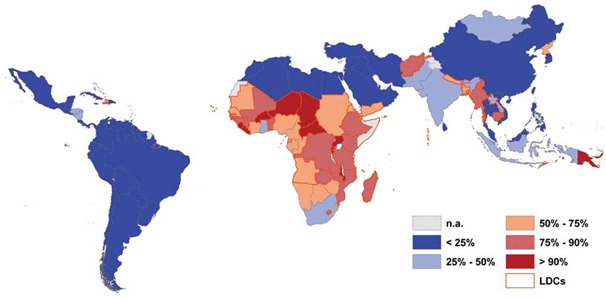
Share of people without electricity access in developing countries, 2008
Source: UNDP and WHO, The Energy Access Situation in Developing Countries A Review Focusing on the Least Developed Countries and Sub-Saharan Africa, November 2009.


